This article gives a brief overview of the “universal” kicks found in the four empty-hand courses taught by the Global Martial Arts University (GMAU). More time is spent highlighting the unique kicking aspects and differences between Karate, Muay Thai, Taekwondo, and Krav Maga. Read on to learn more and find out how you can try out our courses for FREE!
This article compares the kicking techniques found in the four “empty hand” courses offered by Global Marial Arts University (GMAU).
All four martial arts — Karate, Muay Thai, Taekwondo, and Krav Maga — incorporate a variety of kicking techniques.
SIMILARITIES
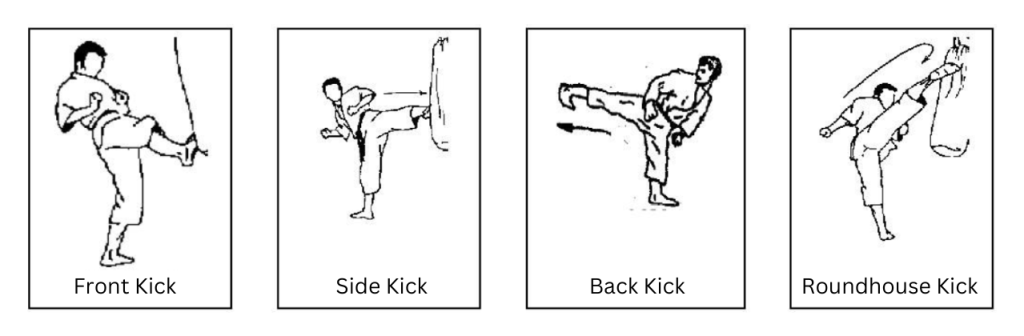
Basic kicks including front kicks, roundhouse kicks, side kicks, and back kicks are found in all four “empty hand” styles taught by the GMAU.
These four kicks are used in similar but unique ways, depending on the martial art. And they’re designed for both offensive and defensive purposes.
Let’s examine the differences across the styles.
DIFFERENCES
“Signature” Kicks by Style
The specific kicks listed below are not necessarily exclusive to the style, but they’re seen more often in that particular style…
Karate: Front Snap Kick (mae geri) and Side Thrust Kick (yoko geri keage).
Muay Thai: Teep (front push kick) and Roundhouse Kick (striking with the shin).
Taekwondo: Axe Kick (naeryeo chagi), Spinning Hook Kick (bandae dollyo chagi), and the Flying Side Kick (twi-myo yeop chagi).
Krav Maga: The Groin Kick (a.k.a., “Krav Maga Handshake”).

Image Source: Adobe Stock
Technique Emphasis
Karate: Focuses on fast and precise strikes, often incorporating a wide range of hand techniques alongside kicks. Some karate styles are more hand striking focused, while other styles use more of a balance of hand strikes and kicks.
Muay Thai: Known for its powerful kicks using the shin, especially to leg targets. This style also incorporates clinching plus hand, elbow, and knee strikes.
Taekwondo: Places a strong emphasis on high, fast kicks with focus on flexibility and speed. It has less emphasis on hand strikes. There’s lots of jumping and spinning kicks in a Taekwondo match.
Krav Maga: Primarily uses straightforward and practical (middle to low height) kicking techniques designed for self-defense scenarios. The four “universal” kicks: front, side, back, roundhouse are the core kicks. Kicks higher than solar plexus level are less common in Krav Maga.
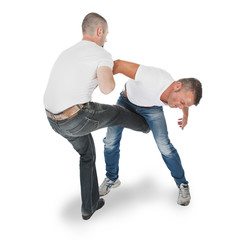
Image Source: Adobe Stock
Stance & Movement
Karate: Employs a mix of front facing and side facing (bladed) stances with linear movements, especially in sport karate. Some karate styles use a deeper, or lower, stance. Because karate is diverse, some styles are more long-distance oriented (e.g., Shotokan) and some emphasize close-range fighting (e.g., Goju Ryu).
Muay Thai: Uses a more upright “squared off’ stance that facilitates kicks, elbows, and knees, with more fluid and sometimes circular movement similar to Western boxing. Because Muay Thai is the “Art of 8 Limbs”, it uses all ranges.
Taekwondo: Emphasizes an upright and bladed stance that enables dynamic footwork for quick and high kicks. There’s also a lot of continuous movement, including bouncing and darting in and out for both offensive attacks and defensive maneuvers. Because of the emphasis on kicks, this is more of a long-range style.
Krav Maga: Focuses on simple and direct movements for practical self-defense, often involving preemptive strikes. It uses a natural, or Western boxing front-facing stance. Because of its focus on self-defense, Krav practitioners are usually out of range (long distance) or close-range clinching, generally avoiding the middle range where it’s easier to be hit.

Image Source: Adobe Stock
Targeting
Karate: Targets a variety of areas, including “vital points”.
Muay Thai: Attacks everywhere: legs, body, and head, with an emphasis on low kicks.
Taekwondo: Emphasizes head-height kicks, showcasing a preference for targeting the upper body.
Krav Maga: Stresses vulnerable areas for quick and effective self-defense — often aiming for the groin, eyes, throat, or knees.
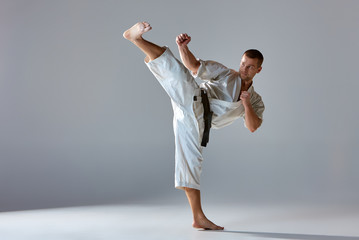
Image Source: Adobe Stock
Training Philosophy
Karate: A traditional martial art with a focus on precise techniques, discipline, and self-improvement.
Muay Thai: Known for its rigorous training, conditioning, and a strong emphasis on live sparring.
Taekwondo: Emphasizes the development of speed, agility, and flexibility.
Krav Maga: Prioritizes practical self-defense techniques for real-world scenarios, often incorporating a mix of kicking, striking, and grappling.
Which Martial Art Should I Choose?
The answer to this question lies solely with you! Here are a few things to consider:
- Choose a style you’re genuinely interested in; by doing so, you’ll be highly motivated to stick to it.
- Consider “why” you want to train. If you want to compete, Karate, Muay Thai, and Taekwondo are good options. Krav Maga is not practiced in a sporting context.
- Because of the emphasis on flexibility and high kicks, Taekwondo may not be the best choice for you. But if it’s the style you’re genuinely interested in, don’t let that hold you back!
- All of these martial arts will provide you with self-defense training, but keep in mind some styles focus more on that than others. Krav Maga, for example, is strictly self-defense and fitness oriented.
And here’s more good news: the GMAU allows you to set up a FREE Beginners Account so you can try out our courses for no cost, and no financial commitment! See details below.
Start Training Today
Global Martial Arts University (GMAU) has all four of these martial-arts programs AND MORE!

Check out the Shotokan Karate course here. Set up a FREE Beginner’s Account and start training TODAY!
Check out the Muay Thai course here. Set up a FREE Beginner’s Account and start training TODAY!
Check out the Taekwondo course here. Set up a FREE Beginner’s Account and start training TODAY!

Check out the Krav Maga course here. Set up a FREE Beginner’s Account and start training TODAY!