
From an original GMAU blog article by Joel Williams; updated and reposted June 2026.
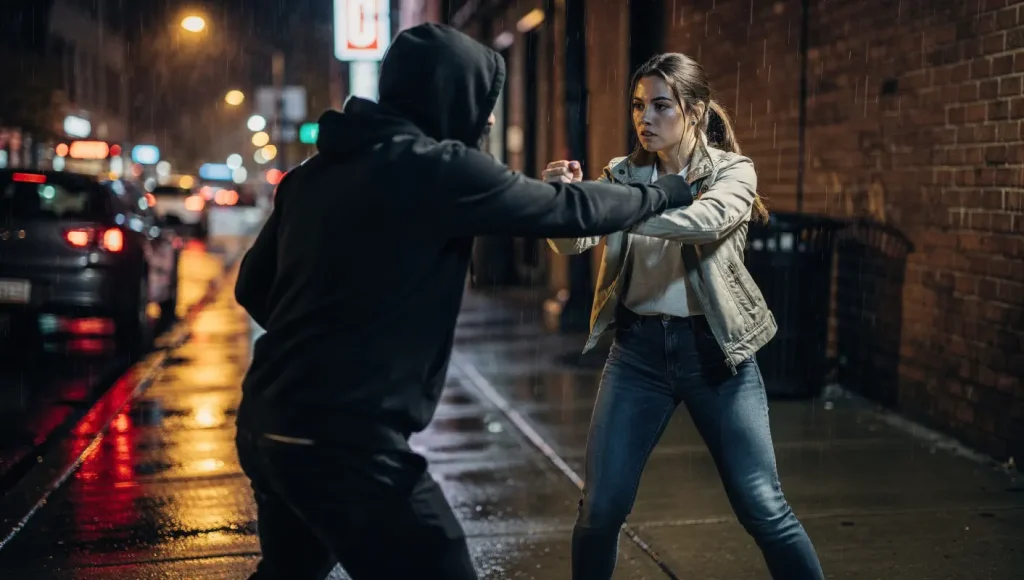
You train hard and practice a lot. But are you actually “ready” for a real-life physical confrontation? Maybe yes, maybe no.
There’s really only one way to know for sure, right? That’s to be in a situation where you have to actually use your knowledge and skills. None of us truly want that. But if you’re practicing martial arts for self-defense, it’s all about being prepared.
One way to train specifically to defend yourself is to organize your training to ensure you’re as prepared as possible to defend yourself against the most probable (or common) attacks. This is exactly what the GMAU Krav Maga program does – it teaches you how to defend yourself against the most common attacks.
Want to know more? Then keep reading!
“Whether it is learned the easy way or the hard way, the truth remains that your safety is yours. It is not the responsibility of the police, the government, industry, the apartment building manager, or the security company.”
― Gavin de Becker
Ever Heard of Goshin Jutsu?

Goshin Jutsu is Japanese for self-defense method or technique. When someone refers to attacks that happen “on the street”, they’re talking about self-defense. Other terms you may see are: reality based self-defense, situational defensive training, or combatives.
In all cases, these learning systems are concerned with teaching you to effectively respond to common attacks. Fortunately, there are uber intelligent (and very experienced) martial artists who have taken the time to do extensive research on “common attacks”, a sub-field of the scientific field of study of martial arts (that particular academic endeavor is called hoplology, by the way). There are many individuals to highlight in this field of study. Let’s look at just one…
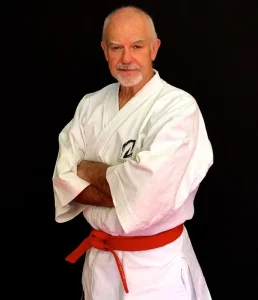
Enter: 9th Dan Black Belt, Hanshi Patrick McCarthy.
Habitual Acts of Physical Violence: The Big Picture
Patrick McCarthy began his training in Canada in the 1960s and was recognized as a major kata, kihon and kumite competitor in the 1970s. After becoming disillusioned by (what he describes as) the lack of reality in the tournament scene, he traveled to Okinawa, Japan and China to find (again, in his words) “real” karate. His journey in the 1980s – 1990s led to the development of a theory of self-defense which he called the “habitual acts of physical violence” (or HAPV, for short). Subsequently, he has written many books and articles on the subject and has developed two-person drills designed to address training against these common attacks.
The following is McCarthy’s complete list of the 36 HAPVs:
- Swinging punches
- Straight punches
- Downward strikes
- Upward strikes
- Swinging kicks
- Straight kicks & knee strikes
- Head butt / spitting
- Biting
- Testicle squeeze
- Augmented foot/leg trips
- Single or double-hand hair pull from the front/rear
- Single or double-hand choke from the front/rear
- Front neck choke from rear
- Classic head-lock
- Front, bent-over, augmented choke (neck-hold)
- Half or full-nelson
- Rear over-arm bear hug (& side variation)
- Rear under-arm bear hug (& side variation)
- Front over-arm bear hug (& side variation)
- Front under-arm bear hug (& side variation)
- Front or rear tackle
- One-handed wrist grab (same & opposite sides-normal/reversed)
- Two-handed wrist grab (normal or reversed)
- Both wrists seized from the front or rear
- Both arms seized from the front or rear
- Single or double shoulder grab from front or rear
- Arm-lock (behind the back)
- Front arm-bar (triceps tendon fulcrum up, supported by wrist)
- Side arm-bar (triceps tendon fulcrum down, supported by wrist)
- Single or double lapel grab
- Single or double-hand shove
- Garment pulled over the head
- Seized & impacted
- Single or double leg/ankle grab from the front (side/rear)
- Ground straddle
- Attacked (kicked/struck) while down.
“The only defense against evil, violent people is good people who are more skilled at violence.”
― Rory Miller
HAPVs in Context

Others have organized this list in additional meaningful ways. Using crime statistics and circumstantial details, for example, it’s known that when men attack men, they strike half the time and grab half the time. This is not usually a surprise attack. It often results from some type of initial verbal confrontation combined with lots of posturing, e.g., puffed up, chest out. This is what Rory Miller, a former corrections officer and tactical team member with training in psychology, who writes and lectures on the topic of violence, calls the “monkey dance”.
“It’s better to avoid than to run; better to run than to de-escalate; better to de-escalate than to fight; better to fight than to die. The very essence of self-defense is a thin list of things that might get you out alive when you are already screwed.”
― Rory Miller
Male versus Male HAPVs
- One person pushes, hands to chest, which is normally followed by the pushee striking first, to the head.
- A swinging punch to the head.
- A front clothing grab, one handed, followed by punch to the head.
- A front clothing grab, two hands, followed by a head butt.
- A front clothing grab, two hands, followed by a knee to the groin.
- A bottle, glass, or ashtray to the head.
- A lashing kick to groin or lower legs.
- A broken bottle/glass jabbed to the face.
- A slash with a knife, most commonly a 3-to-4″ lockblade knife or kitchen utility knife (apart from muggings, sexual assaults and gang violence, the hunting/combat knife is seldom used).
- A grappling-style head lock.
“Men commit 80% of all violent crimes and are twice as likely to become the victims of aggressive behavior.”
― Lawrence Kane & Kris Wilder
When men attack women, they almost always grab them in some way along with an element of surprise.
Male versus Female (General) HAPVs
- The victim is approached from the rear/side/front, a threat is made with a weapon that had been hidden, then the victim’s right upper arm is held by the attacker’s left hand and the victim is led away.
- A silent or rushing approach is made from the victim’s rear, and then a rear neck/head lock is applied and the victim is dragged away.
- The same approach as in #2, above, with a rear waist grab; the victim is then carried/dragged away, normally into bushes or an alley, etc.
- The victim is pinned to a wall with a throat grab done with the attacker’s left hand; a weapon is shown to threaten the victim and is then hidden, and the victim is led away.
- The victim is approached from rear/ front/side, the attacker grabsthe victim’s hair with his left hand, and then she is dragged away.
Male versus Female (Most Common Wrist Grips) HAPVs
- The attacker’s left hand, thumb uppermost, grips the victim’s raised right wrist; the attacker threatens with his right hand.
- With the victim’s right arm down, the attacker grips the victim’s right upper arm with his left hand and her right wrist with his right hand.
- The victim raises both arms and the attacked grops both of her wrists; the attacker’s hands are vertical with his thumbs uppermost.
- With the victim’s arms down, the attacker grabs both upper arms.
- With the victim’s right arm down, the attacker’s left hand grabs just below the right elbow and his right hand grabs her wrist.
“It is understandable that the perspectives of men and women on safety are so different–men and women live in different worlds…at core, men are afraid women will laugh at them, while at core, women are afraid men will kill them.”
― Gavin de Becker
HAPVs & the KISS Principle

Hanshi Patrick McCarthy also simplifies the list of 36 HAPVs by collapsing them into 3 basic categories:
- Seizing (grabs, chokes, bear hugs, pins/holds, etc.)
- Impacting (punching, kicking, slapping, elbowing, etc.)
- Combinations (2-handed grab + knee, ground & pound, etc.)
If you think of them in this way, the list of 36 common attacks (a number large enough to potentially overwhelm those with little to no martial arts, combat or fighting experience) seems much more “manageable”.
Now that we have divided the attacks into smaller groups, we can get to work figuring out what to do in those situations and how to best respond to each specific threat.
The GMAU Krav Maga Solution

The GMAU Krav Maga program addresses each of the 36 HAPVs (and more). Beginning at the white belt level, you learn to strike, kick, defend against a choke, and grapple while standing. In other words, the curriculum addresses all “ranges” of combat from the beginning of the program.
As you progress through the Krav Maga belt levels, you learn blocks and additional strikes and kicks (through the black-belt level). More standing grappling and ground defense instruction is taught at the intermediate belt levels and continues through the black-belt level. Defenses against weapons begins at the intermediate levels through black belt.
Common Attack #1 – Seizing Defense
- An attacker grabs Leslie in a front choke hold.
 Leslie takes a step back with her left leg, raises her right arm and breaks the choke hold with a turn of her body.
 After breaking the attacker’s choke, Leslie sweeps his arms away; she’s now free from the choke.
Common Attack #2 – Impacting Defense
- An attacker throws a haymaker style punch at Leslie.
- She steps in toward the punch and defends with a high 360 block.
- Leslie follows up with a flurry of palm-heel strikes to the attacker.
Common Attack #3 – Defending a Combined Seizing + Impacting Attack
- An attacker grabs Leslie’s shirt (seize) and attempts to punch her (impact).
- Leslie steps toward him and blocks his arm; she then overhooks the attacker’s grabbing arm using triceps control and creates a frame with the other elbow and forearm.
- From this side clinch position she is protected and can deliver strikes, including knees and groin kicks.
The GMAU Krav Maga Program
Are you looking for an affordable and convenient way to learn how to protect yourself and others? The Global Martial Arts University offers an exceptional online Krav Maga course.
Set up a FREE Beginner’s Account and start training TODAY!

The GMAU Krav Maga Instructor Certification Program
Do you have dreams of being a qualified self-defense instructor with access to hundreds of hours of lessons and classes? The Global Martial Arts University offers an outstanding online Krav Maga Instructor Certification program.

Additional Resources
If you want to learn more about the nature and psychology of violence, the following are three highly recommended books on these topics:








Pingback: The 3 Most Common Street Attacks & How to Defend Them – Princeton Club