

You’ve been practicing martial-arts techniques consistently, but there’s one challenge you may still encounter: performing those techniques repeatedly without becoming exhausted. A few combinations feel manageable, but as the session continues, your movements become slower, your stance begins to weaken, and your concentration starts to fade. This is where conditioning becomes important.
In martial arts, fight conditioning generally refers to developing the cardiovascular endurance, muscular stamina, and ability to repeat movements needed for demanding training. Many people associate it exclusively with sparring, but you can develop several important aspects of conditioning without engaging in a single sparring session. Whether you train through an online program, practice independently at home, or prefer not to participate in contact activities, structured conditioning can help you improve your fitness and maintain the quality of your techniques as fatigue increases.

By TungCheung
Understanding What You’re Training For
Sparring can develop valuable abilities, including timing, distance judgment, decision-making, and responding to an unpredictable partner. However, it isn’t the only way to improve physical conditioning.
Repeated techniques, sustained footwork, bodyweight exercises, and carefully structured intervals can challenge your cardiovascular system and muscular endurance. These activities allow you to control the pace, adjust the difficulty, and focus on the physical demands of training without the contact involved in sparring.
It’s important to recognize the distinction: conditioning without sparring can improve your capacity to work, but it cannot fully reproduce the unpredictable decisions and interactions involved in live practice. If your goal includes practical self-defense, physical conditioning should complement appropriate instruction in awareness, decision-making, and technique.
By Pete
Build Conditioning Around Martial Arts Movements
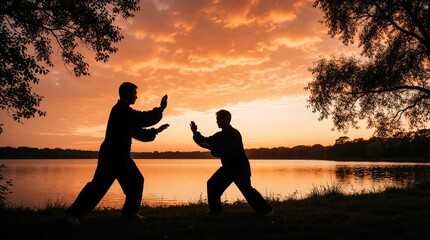
One of the most useful approaches is to build workouts around movements you already practice. Instead of relying exclusively on generic exercises, combine controlled stances, footwork, hand techniques, kicks appropriate to your ability, and familiar forms into structured rounds.
For example, you might practice a basic combination continuously for 30 seconds, rest for 30 to 60 seconds, and repeat several times. Another round could focus on moving between stances while maintaining proper posture. You could also perform a familiar form at a steady pace, rest, and repeat while concentrating on accuracy.
The purpose is not to move as quickly as possible. It’s to maintain good technique while gradually increasing the amount of work you can perform. If your movements become uncontrolled, shorten the interval, reduce the intensity, or take additional rest.

By 69
Combine Cardio and Strength Endurance
Martial arts demands both cardiovascular fitness and the ability to repeat muscular efforts. Developing only one of these areas may leave gaps in your conditioning.
Activities such as brisk walking, cycling, and swimming can improve general endurance. Bodyweight exercises such as controlled squats, wall push-ups, and appropriately modified planks can help develop the muscular endurance needed to support stable movement and posture.
You can combine these activities across the week rather than trying to fit everything into one exhausting workout. For example, dedicate some sessions to steady cardio, others to martial arts movement intervals, and others to basic strength exercises. Allow enough recovery between harder sessions, especially when you are new to conditioning or returning after a break.

By Mitchell
Progress Gradually and Measure Improvement
A common mistake is to begin with workouts that are too difficult. Enthusiasm may encourage you to perform long intervals, complete numerous repetitions, or train intensely every day. However, excessive fatigue can interfere with recovery and increase the likelihood of injury.
Start with a manageable workload and track simple measures of progress. Can you complete the same number of rounds with better technique? Can you recover more comfortably between intervals? Can you maintain your stance and posture throughout a longer sequence?
These improvements are meaningful indicators that your conditioning is developing. Increase only one variable at a time, such as the duration of a round, the number of repetitions, or the total number of rounds.
The Bottom Line
You don’t have to spar to develop better martial-arts conditioning. Structured technique practice, low-impact cardio, bodyweight exercises, and planned work-and-rest intervals can all help you build the stamina required for demanding training.
The key is to train with a purpose. Choose exercises that match your current ability, maintain control as fatigue increases, and give your body enough time to recover.
Better conditioning won’t replace technical skill or live practice where appropriate, but it can help you get more out of every training session. The objective is to build a body that can keep working while allowing your martial-arts skills to remain sharp.
The GMAU Combat Strong Program

Global Martial Arts University has a modern, science-based strength and endurance course called Combat Strong. This course is designed with the martial artist in mind. It’s also a great total-body workout for non-martial artists!
Check out the course overview and learn more about the coach, Weston Titus. You can even try a FREE workout!
SIGN UP today and get Combat Strong!