

Shadowboxing is one of the most versatile training tools in martial arts. It requires no equipment, can be done anywhere, and enables you to develop technique, timing, and movement without a partner. And while commonly associated with striking sports, shadowboxing can benefit athletes from nearly every martial-arts style. This blog post highlights different types of shadowboxing.

by Jacob Lund
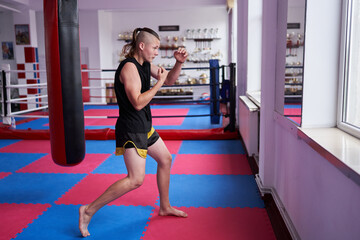
Technical Shadowboxing
Technical shadowboxing focuses on clean execution rather than speed or power. Movements are performed slowly and deliberately to reinforce proper mechanics.
Key elements include:
- Controlled footwork – Purposeful and efficient movement of the feet that maintains distance, positioning, and balance during techniques.
- Balanced posture – Proper body alignment that keeps the center of gravity stable and allows quick, controlled movement.
- Precise hand positioning – Accurate placement of the hands for effective striking, defense, and protection.
- Smooth transitions between techniques – Fluid movement from one technique to another without pauses or loss of balance.
This variation is particularly helpful for beginners learning new techniques or experienced athletes refining their mechanics.
by Xalanx
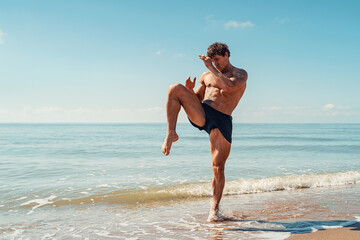
Defensive Shadowboxing
Many martial artists spend most of their shadowboxing time attacking, but defense is equally important.
Defensive shadowboxing includes movements such as:
- Slips – Small head or upper-body movements that avoid an incoming strike without stepping away.
- Rolls – Circular upper-body movements used to move under or around an incoming strike.
- Blocks – Defensive actions that stop or absorb an opponent’s strike with the arms or other parts of the body.
- Parries – Deflections that redirect an opponent’s strike away from its target.
- Angles and pivots – Footwork movements that change positioning or direction to create a better offensive or defensive angle.
Imagine an opponent throwing strikes and practice reacting to them. This approach builds reflexes and spatial awareness.
by ZaStock
Scenario-Based Shadowboxing
In this variation, you visualize specific situations and respond with appropriate techniques.
Examples include:
- Escaping from the corner – Using footwork and defensive movement to move out of a confined position and regain space.
- Countering a jab – Responding to an opponent’s jab with a defensive action followed by an immediate offensive technique.
- Setting up a takedown entry – Using strikes, movement, or feints to create an opportunity to safely initiate a takedown.
- Maintaining distance against an aggressive opponent – Using footwork, positioning, and defensive techniques to keep an advancing opponent at a controlled range.
Scenario-based shadowboxing builds tactical thinking and helps translate techniques into realistic applications.

by Miljan Živković
Grappling Shadowboxing
Even grappling-based martial arts can benefit from the following solo-movement shadowboxing drills:
- Level changes – Lowering the body’s height by bending the knees and hips to prepare for attacks such as takedowns.
- Penetration steps – Forward stepping movements used to close distance and enter into a takedown.
- Sprawls – A defensive movement where the hips are dropped back and down to prevent or counter a takedown attempt.
- Hip escapes – A movement that shifts the hips away from an opponent to create space or improve position.
- Guard transitions – Shifting between different guard positions to improve control, defense, or attacking opportunities.
These movements help reinforce fundamental patterns that are critical in live grappling exchanges.

by Lila Patel
Conditioning Shadowboxing
This variation increases intensity to build endurance and coordination. Rounds might include fast combinations, explosive footwork, or continuous movement without pauses. Conditioning rounds simulate the pace of competition and help improve cardiovascular fitness.

by Chris Titze Imaging
Keep It Intentional
Regardless of the shadowboxing variation you choose, the most important element is intention. Each movement should have a purpose. Visualize an opponent, imagine their reactions, and stay mentally engaged throughout the round.
Shadowboxing done with focus becomes one of the most effective ways to sharpen your martial-arts skills.
The GMAU Muay Thai Program
Shadowboxing is a key component of Muay Thai training, for example.
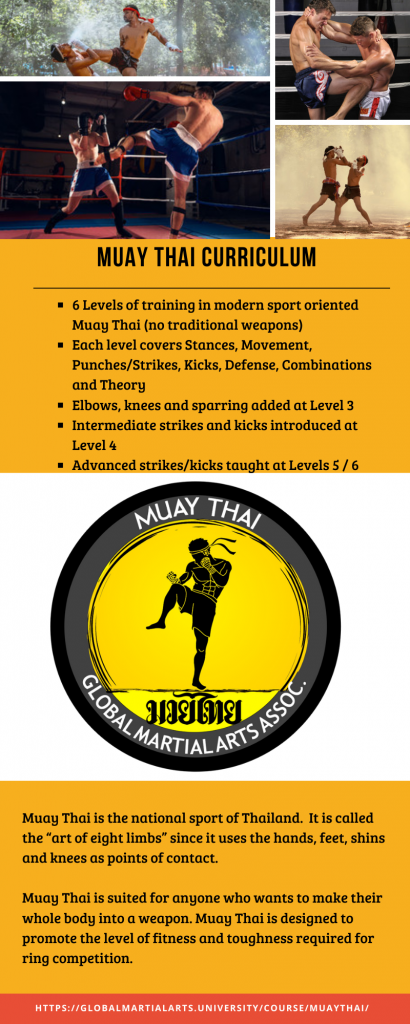
Check out this GMAU Level 1 Muay Thai class with a segment on shadowboxing:
Want to learn Muay Thai from a high-level instructor in the comfort of your own home? Check out the GMAU Muay Thai course!
Set up a FREE Beginner’s Account and start training TODAY!







Pingback: Shadowboxing Variations for All Martial Arts Styles – Princeton Club