Hojo undo is a term in martial arts that’s associated with Okinawan martial-art styles, including karate. It refers to supplementary training exercises that help develop strength, power, endurance, and body conditioning. Hojo undo aims to enhance a practitioner’s physical abilities and reinforce the principles of their martial art. Read on to learn more about these “old school” training methods.
Introduction
This article provides an overview of hojo undo, which encompasses a variety of training tools, techniques, and methods for developing power, strength, endurance, and body conditioning for martial arts.
Many of these tools and methods originated in China and were used by practitioners of kung fu. As martial arts spread throughout Asia, these tools and techniques found their way to Okinawa, Japan, and other areas. There they continued in their original form, were modified, or inspired the development of new implements and methods.
The following is an overview of the primary hojo undo lifting implements. Under the hojo undo umbrella term, body conditioning methods are also included. But those will be highlighted in a separate blog article.
The list, below, gives a good introduction to the most common lifting implements and methods for developing muscular strength, power, and endurance.
Junbi Undo
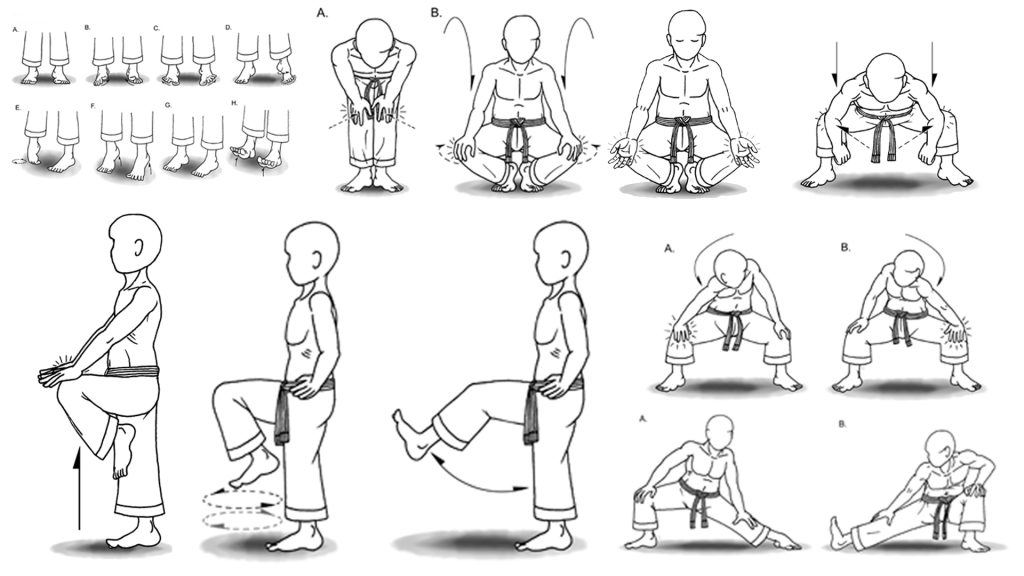
Junbi undo is a term in martial arts, specifically in Japanese disciplines such as karate. It translates to “preparatory exercises” and involves warm-up routines and drills designed to prepare the body and mind for training or practice.
These exercises include stretches, joint rotations, and basic movements to increase flexibility, circulation, and focus before engaging in more intense martial-arts activities. Junbi undo is an essential part of a martial artist’s routine to reduce the risk of injuries and optimize performance.
Junbi undo is not the focus of this article, but it’s important to know that many traditional martial arts (especially karate) include systematic warm-up methods or sequences to prepare the body for training.
Lifting Implements
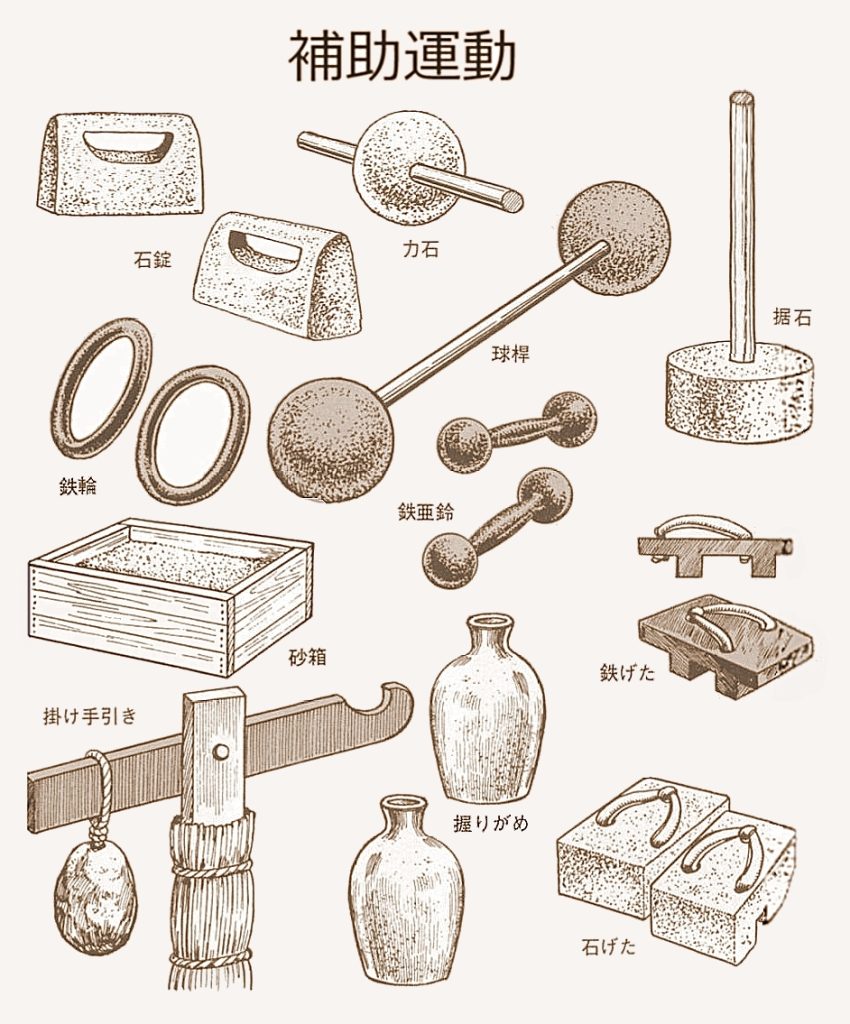
Mikiage Kigu (巻揚器具) “Wrist Roller”

The makiage kigu is a rope attached to a wooden bar at one end and a weight at the other end. The martial artist holds the wooden bar and rotates his hands. This causes the rope to curl around the wooden bar and the weight to rise up towards the bar. This traditional training tool is used by some martial artists to develop hand, wrist, and forearm strength.
Chi Ishi (鎚石) “Strength Stone”
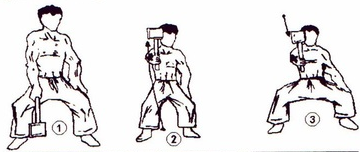
Chi ishi is a traditional hojo undo training tool used in Okinawan martial arts, especially in karate. The term chi ishi roughly translates to “strength stone” in English. It’s basically a stone weight connected to a short wooden handle. Practitioners use chi ishi for strength training, grip development, and to improve overall conditioning.
Nigiri Game (握り甕) “Gripping Jars”

Also used in Okinawan martial arts, the nigiri game training tool is a pair of small, weighted jars with handles. Nigiri game translates to “gripping jars” in English. The jars are used to develop grip strength, forearm strength, and overall hand conditioning. Practitioners perform various exercises, such as lifting and rotating the jars, as part of their supplementary hojo undo training.
Tan (担) “Barbell”
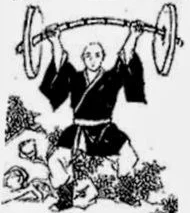
The barbell has long been a staple of weight training the world over, and Okinawa is no exception. Before Pkiniwan martial artists had modern steel barbells, they trained with automobile wheels and axles. Before that, they used stone weights on both ends of a pole, which they called a tan.
Kongoken (金剛圏 ) “Metal Bar”
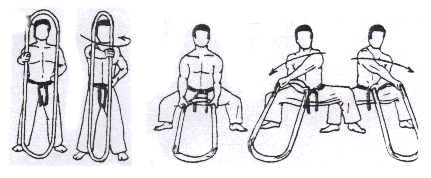
Kongoken is a large, heavy iron-ring used for full body strength training and conditioning. It’s a traditional Okinawan-karate hojo undo training tool. Kongoken exercises often incorporate dynamic movements to build power in the upper body, shoulders, and arms.
Ishi Sashi (石錠) “Stone Padlock”

Ishi sashi is a traditional Okinawan hojo undo training tool. Its name roughly translates to “stone padlock” in English. Practitioners use ishi sashi for strength training, conditioning, and grip development.
Tetsu Geta (鉄下駄) “Iron Sandals”
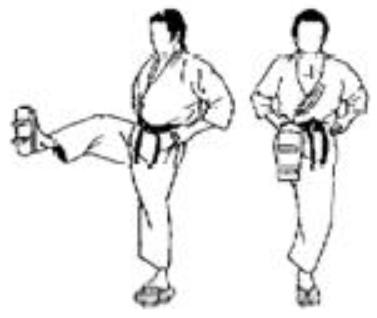
The term tetsu geta combines “tetsu,” which means iron, and “geta,” which typically refers to traditional Japanese wooden sandals. These sandals weigh about 3 to 5 kilograms. This karate training tool, also known as “Iron Clogs”, were used to strengthen the legs and develop kicking power. They’re used in a similar way to modern ankle-weights.
Other Hojo Undo Training Methods
Hojo undo also includes other tools and methods for body conditioning. These include implements to strike the body (e.g., tetsutaba, or steel beater) and targets that martial artists strike (e.g., makiwara, or sand bucket) to “toughen” their bodies and spirits.
In addition, there are hojo undo drills that can be done with a partner to toughen the body. These include striking arms or shins together. Again, these methods will be covered in a future blog post.
Like with any training, you shouldn’t try any of these training tools or methods without first getting proper instruction in them from an experienced practitioner. Otherwise, you could suffer serious injuries.
The GMAU Combat Strong Program
With caution, the “old school” training tools and methods outlined in this blog post can be added to your training program.
Note also that the Global Martial Arts University has a modern, science-based strength and endurance course called Combat Strong. This course is designed with the martial artist in mind. It’s also a great total-body workout for non-martial artists!
Check out the course overview and learn more about the coach, Weston Titus. You can even try a FREE workout!
SIGN UP today and get Combat Strong!