Republished October, 2026
Most people assume running a martial-arts school means one thing: lease a space, fill it with students, and grind. But there are at least five distinct business models, and the one you’re in may be costing you time and money you don’t need to spend. It may also be frustrating you for no good reason.
This article covers the pros and cons of each model:
- Part-time school.
- Full-time commercial school.
- Private academy.
- Online school.
- Private lessons only.
Who’s Behind This Advice
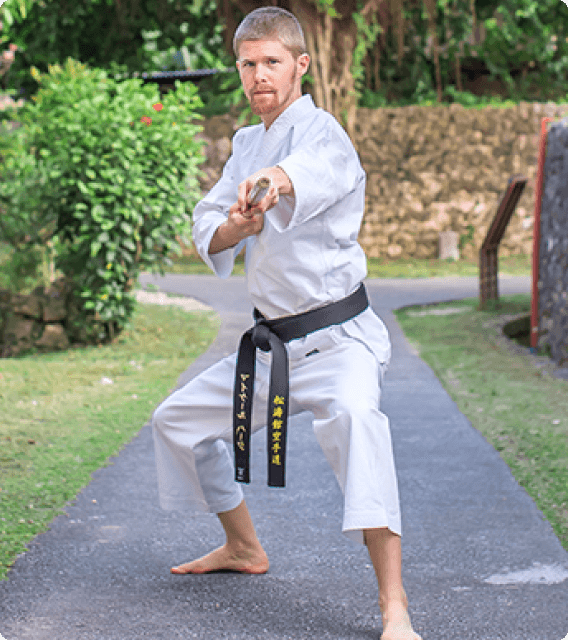
Michael Hodge is the founder of the Global Martial Arts University (GMAU), a leading online martial-arts school, with an association of instructors and locations around the world. He has operated several of these business models firsthand, including a part-time school, a full-time commercial school, and the online school (the GMAU) he started in 2008. He has also taught private lessons.

Above Everything Else: Be a Great Teacher
None of these models work unless you’re a good instructor. Business models, marketing systems, and school management software are all useful, but they’re bells and whistles. At the end of the day, you are the product. Students come back for the quality of what happens on the mat, which is why the GMAU’s Certified Martial Arts Teacher (CMAT) course includes the word “teacher”. Sharpen your teaching first. Then optimize everything else.
Model 1: The Part-Time School
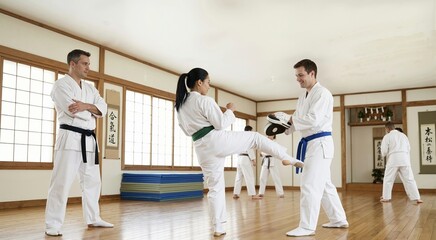
This is where most instructors start, and it’s a perfectly good place to be. You keep your day job (or stay in college), and you teach on the side because you love it. You’re a black belt with some experience, and you want to share what you know in a more impactful way.
How it works. The cheapest way in is to rent space from a community center, a YMCA, or anywhere you can get a simple agreement with minimal cost. You run a couple of classes a week and market them. With no lease, no utilities, and no payroll, your overhead stays low, and the school can still do well.
You might also lease a small brick-and-mortar space. That’s how Hodge started. As a teenager, he helped at his father’s school, Texas Karate Academy, and was running most of the business by 17. When he turned 18, he was old enough to sign the lease, and his father handed the school over to him. It had about 30 students. Hodge ran it three nights a week while attending college, with no employees and low costs. It was manageable and it worked.
The upside. Low overhead, low risk, and a steady income. You can stay here for years, and with the strategies in the private-academy section below, you can make a part-time school very profitable.
The catch. Eventually you may hit a breaking point: the moment you’re ready to go all in. If you want a school of 100, 200, or 300 students that outearns your day job, you’ll have to make teaching your full-time profession. Location matters too. In a tiny town, sustaining 200 to 300 students may not be realistic.

Model 2: The Full-Time Commercial School
This is the whole enchilada. Teaching is your only income, so the school has to work.
Hodge made this leap in 2009, moving into a larger leased space. Here’s what changes when you go full time.
You’ll need help. Your first hire should be a front-desk person or administrative assistant. They answer calls, schedule appointments, take payments, and talk with students between classes, which frees you to teach great classes and enroll new students. With one part-time front-desk hire, you can get surprisingly far on your own.
To grow beyond roughly 100 students, you’ll need an assistant instructor or a second instructor. Otherwise you’re teaching 20-plus classes a week while also handling marketing, management, and enrollments, and you’ll hit a ceiling fast.
Costs go up. Employees cost money, and so does marketing. A full-time school can’t sit around waiting for the phone to ring or for social-media leads to trickle in. You need a steady flow of new students every month, which means outbound work.
You can become an absentee owner, with a major asterisk. Some owners do it, and Hodge did for a while. But a school still needs a head instructor, manager, or owner who is involved enough to give staff confidence and direction. That’s a whole other topic.
What it looks like in practice. Hodge ran his commercial school for four years and grew it to around 200 students. It made the cover of MASuccess Magazine in 2012, and he sold it to one of his instructors in early 2013 to focus on the GMAU full time. By any measure, it was a successful operation.
It was also exhausting. His days looked like this:
- Arrive around 8:00 AM, Monday through Thursday, and work until about 9:00 PM.
- Spend the first half of the day on management, marketing, and business tasks.
- Spend 4:00 to 9:00 PM on “showtime”: teaching and enrollments.
- Work shorter hours on Fridays and about 8:00 AM to 3:00 PM on Saturdays.
Marketing consumed a huge amount of time and energy. It kept new people coming through the door, but it was stressful. If you don’t manage the workload carefully, a full-time commercial school can burn you out.

Model 3: The Private Academy
This model is very different from the full-time commercial school, and many instructors have never heard of it. Instead of chasing new students all year, you run your school the way a private school runs.
The concept. A private academy works like a private school for children, and that’s exactly how you explain it to parents. You offer a limited number of spots for the entire school year. Families must enroll before a set deadline (say, August 31) to join a program that runs from September through the end of May. They pay the yearly tuition upfront or in monthly payments, just as they would at a private school. Spots are limited because your program is the best in the area, and you can back that up. It teaches realistic, useful, fun martial arts, with a big emphasis on character development, community, and leadership engagement. Monthly character development sheets and action assignments give families something tangible to see.
Why kids are easier, and why adults work too. Parents already understand how private schools work, so you’re not inventing a new concept. You’re showing how your martial arts program fits into one they already know. You can run a private academy for adults, but the school-year framework is simpler to sell to families.
Why it’s a game changer. You aren’t scrapping for leads. You’re not doing outbound marketing for hours a day, running booths, setting up lead boxes, making phone calls, or throwing birthday parties just to generate prospects. You’re not competing with the strip-mall Taekwondo school down the street that’s marketing aggressively. You’ve stepped out of that game entirely and into something different and better. Because your marketing needs shrink to a few Facebook posts and a request for referrals, the model can work even in a small market where a big commercial school would struggle.
The key ingredients.
- Limited space. A set number of spots creates exclusivity and demand.
- Registration periods. You don’t enroll people whenever they call.
- Structured entry points. New students begin right after a testing cycle ends, when a new rotation starts. Signing someone up mid-cycle, a few weeks before a test, is a confusing time to begin. Many schools do it anyway because they need bodies on the floor, but it’s a worse experience for the student.
- A waiting list. If a student moves away or drops out mid-year, you call the next person on the list. If they’re no longer interested, post on Facebook to announce an opening. Either way, the new student starts after the next test.
How to set your numbers. Your capacity is set by what one instructor can teach well in the space you have. Start conservatively, and raise the cap only when you’re sure you can handle it. Remember that your whole roster rarely shows up at once. Someone is always sick or busy, so expect roughly 85 to 90 percent attendance.
The time payoff. With a full roster before the year even starts, a handful of classes a week, and a curriculum that’s already organized, your time investment drops dramatically. You spend a little time planning each month, and then it’s about walking onto the mat and delivering a great class every time. That isn’t a lower-quality experience. As your teaching experience grows, preparation gets easier, and students know you’ll show up ready with something fresh.

Model 4: The Online School
You can build a martial-arts school that has no physical location at all. That’s the GMAU, which Hodge started in 2008. It began with home-study DVDs and accompanying manuals. Students filmed themselves and mailed in a video (sometimes a disc) for grading. Thanks to YouTube and other online streaming-video platforms, it has improved enormously since then.
Answering the skeptics. The first criticism is always about feedback: how would students know if they’re doing something wrong? The answer is video assignments and video exams, which instructors watch, grade, and comment on. This can be more personalized than a live class. In a room of 20 students, your instructor corrects you occasionally, but you’re one of 20. In an online program, the instructor watches your material and focuses only on you at that moment.
The second criticism is about sparring and fighting skill. If students have a training partner, the programs show them how to practice and spar.
The trade-offs. Building an online school from scratch is significantly harder than opening a local school, especially if you want custom technology like the GMAU’s. But it has real advantages:
- Location independence. If you have an internet connection, you can film classes and grade exams from anywhere, including a vacation in Australia.
- Reach. You can serve people who live far from any school or work odd schedules that make live classes impossible.
- Affordability. Hodge once spoke with a man who wanted to take Krav Maga, but the only nearby school charged $189 a month, which he couldn’t afford. The GMAU’s lower price made training possible.

Model 5: Private Lessons Only
Can a school consist only of one-on-one lessons? Absolutely. Music and dance teachers do it all the time.
How it works. You skip group classes entirely. You teach in a garage dojo, a spare room, or a rented fitness space, or you travel to students’ homes (in which case, charge extra). Your overhead should be extremely low, and that’s the point.
Who it’s for. Private lessons suit students who would never join a group class, such as people who lack confidence, have special needs or goals, or can’t find what they want nearby. It’s also a good fit if you have specialized skills, such as self-protection or Krav Maga, in an area where the only option is traditional Taekwondo.
The garage dojo. One of the easiest ways to start is to turn your garage into a dojo. Put down mats, make it comfortable, and you have a teaching space with essentially no added overhead, since you’re already paying your mortgage and expenses. Plenty of people run businesses from home, from massage therapists to music teachers. Check your local zoning and business laws first, because the rules can differ inside and outside city limits. Also, contact your insurance agent to add home-based business coverage to insure the equipment and liability.
Pricing.
- Sell packages, not single lessons. Have students buy eight or 16 lessons at a time, or a monthly bundle. Price per lesson, then discount the package.
- Charge about double the group rate. If local schools charge $150 a month for group classes, charge at least $300 a month for private instruction.
- Run the numbers. If you charge $250 a month for four lessons, 20 students bring in $5,000 a month with basically no overhead.
Marketing. People wonder how students will find you without signage or a storefront. A martial-arts school doesn’t need a main-street location. It isn’t a hotel, a gas station, or a restaurant. Get a good Google Business listing, set up a simple Facebook page, post regularly, run geographically targeted Facebook ads, and list yourself on Craigslist. Start with one good student, and word of mouth will bring more.
A Bonus Option: The Pop-Up Dojo
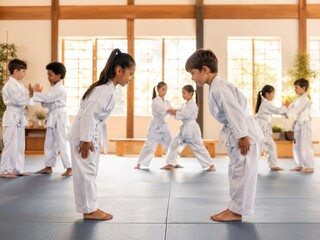
Instead of bringing students to you, take the class to them. Approach daycares, preschools, academic schools, and summer camps with a simple pitch: “I’ll come every Tuesday at 10:00 AM and teach a special class for your students, for $50 a month per child. I’ll bring my own mitts and equipment if you let me use your gym.”
You have no overhead and plenty of flexibility, and people already do this with basketball clinics, dance, and gymnastics. You do have to walk in the door and ask, so don’t be shy. You have real value to offer. Martial arts can transform a child or an adult for the better, and this should motivate you to put yourself out there.

Rethinking Where You Are
Many instructors follow an evolutionary path: private lessons, then a part-time school, then a full-time commercial school. Some then realize they never needed $10,000 to $20,000 a month in overhead, a 10,000-square-foot mega school, or five locations. A leaner model might have given them a better life from the start.
Don’t choose a model out of habit or because you think it’s what a “real” school looks like. Choose the one that lets you enjoy your life and do what you love.
Absolute vs. Relative Income
Consider this distinction when you compare models:
- Absolute income is the total you earn in a year. If you made $100,000, it doesn’t matter whether you worked 90 hours a week to get it.
- Relative income is what you earn per hour of work.
A big commercial school produces bigger numbers, but it also brings employees, overhead, and long hours. A lean model, such as a private academy or private lessons, can earn less in total yet pay more for every hour you work. Working smarter beats working harder.
Choose Your Model and Live It Out
Part-time school, full-time commercial school, private academy, online school, or private lessons: any of these can work if you’re a great teacher. The key is picking the one that fits the life you want, then committing to it fully.